Saturday, June 24, 2017

Trump as Pure Ideology

Original Article: To Believe Trump You Must Believe Contradictory Things

Me: Trump is Pure Ideology


Kenny-Evitt: What? Isn't Trump the least ideological politician?


Me:


The one liner was a reference to contradiction again. “Pure ideology!” is a Zizekian gasp of exasperation at something that is empty and meaningless, bereft of any substance but its ideological structure.

As Zizek says “pure ideology is impossible.” What does this mean? That statements of an ideology, when closely studied and interrogated, reveal themselves to be vapid and contradictory.

This is why I have no problem with an artwork being “too ideological.” If say, a film is part of patriachal ideology and denigrates women, rather than considering this a “bad influence’ on our culture, studying it reveals exactly the profound errors that ideology has about women. The famously racist and ideological movie “Birth of a Nation”, shows how white racists viewed black people as ravening monsters who cannot control themselves when it comes to white women BUT ALSO as clever, urbane politicians who manipulate us. The more ideological a work is, the more it displays the seams of that belief system. For a work to be “pure ideology” would mean it would end up being nothing but seams - ie, impossible.

So you bring up that Trump was a non-ideological candidate. Indeed that was some of his appeal - this unsophisticated man who said government should protect healthcare, and the Iraq War was bad, and we didn’t need tax cuts. Even his focus on immigration was obviously different from normal Republicans, who were catering to both a business class that wanted more labor, and hopes to convert socially conservative hispanic voters. Ted Cruz was considered “the ideologically pure” candidate of that primary. Trump was like a barbaric yawp that was a violent, chaotic reaction to the stultifying Republican ideology that was no longer functional. If anything he came across as tribalist, representing and serving one particular group of people who could identify with him.

One could have imagined non-ideological President Trump: cancelling NAFTA, passing infrastructure deals with Democrats, appointing New York cronies from both sides of the aisle, being rude but speaking blunt truth in the voice of the common man.

But just in the way that a rebel overthrowing a tyrannical ruler can themselves become a dictator, the amorphous chaos that comes from rebelling ideology, can crystalize into it’s own ideological order once it comes into its own. (Which is why we must be careful and not give away our ethical principles when we get power.)

Through the unfortunate combination of “establishment Republicans deciding to defend/enable President Trump” and “Trump needing Republicans to defend him”, he’s accelerated past even the Ted Cruz’s of the world.

See, most ideology still has some adherence to the principles it began with. Social justice ideology still tries to be about fighting racism, and helping the lowest of society. They know their principles even if they are bad at them and routinely sell them out. Similarly, an early or weak ideology still interfaces with the facts of the world, acknowledges inconvenient reality, etc.

A very powerful, endgame ideology does not do any of that. All statements and actions are solely based on “what is comfortable.” To Trump it is comfortable that the leakers are lawbreakers, and that the leakers don’t exist, so both statements are true in the world generated by his ideology.

Every single one of the Republican ideals Trump pays paeans to (because to disagree would be an uncomfortable argument) and completely ignores in his actions. He’s moved beyond having to care about those principles. He indulges himself, terrifies everyone around him, and rubber stamps whatever comes across his desk so long as the people sending it promise not to investigate him. He certainly has not passed laws to benefit the WWC tribe or appointed members from that group.

This hasn’t created a non-ideological presidency, but because Trump is a needy child, it’s created a White House that is pure ideology - trying to comfort the child 100% of the time and bending reality in all ways in order to do this. There ends up being no “there” there.

Tuesday, June 13, 2017

Axes, Solving Systemic Problems, and Power

@theunitofcaring and @shieldfoss explored one of the contradictions we have about professional environments and how they can support minorities. This is a subject @rasienna discusses a lot. Sometimes people note than an intensely tribal office culture can exclude people who don’t share the interests and backgrounds of the prevailing employees. Sometimes people note that an extremely standardized, corporate environment is based on rules set up by the kyriarchy, and will be most accessible to people used to those rules.
Informal vs formal. Or even more fundamentally, chaos vs order. Which way lies more justice?
And it is tremendously easy to get tricked by this question. You can see some examples where one method led to the exclusion of an otherwise worthy worker or member of the community, and feel “Damned informality, it must be a tool of oppression!”
Someone didn’t get what the office jokes were about and so acted awkwardly. Informal office culture doomed their career.
... or, someone didn’t go to the right college and have the right standardized experience and classes, and no one appreciated the intangible of diversity they brought to the team over the Generic White Guy With A Good Resume, so an overly formal office culture dooms their career.
It’s easy to tell yourself this story, and end up crusading against that type of office culture everywhere. Now you’ve assigned yourself to chaos or order in some never-ending battle, and you think it’s what will always benefit the disadvantaged.
Here’s the thing: Power doesn’t give a fuck about chaos or order. It’s power. It will figure out how to flow either in a very informal environment, or how adapt to an extremely rigid one. If one group systematically has more money and representation and influence, then they will do just fine, whether you’ve got a casual laid back office that feels like a family, or a corporate hierarchy run solely by forms and algorithms.
Our enemy is always Power. Millions of women and black people and people without a college education are held back from anyone seeing their potential, because they don’t look or talk like the people with money and influence. When you see instantiations of this discrimination, you should try to stop it, and give a hand up to those people. You should always sympathize with the excluded.
You don’t need to say “all informal offices are toxic” or “all corporate hierarchies are inherently patriarchal.” Different people flourish in both chaos and order. There should be workplaces for either of them. There should be a workplace for the hispanic coder who gains knowledge of a new part of society because of how many friends she meets at work. There should be a workplace for the single mother who needs to fit a very consistent schedule so her children and babysitters aren’t caught flat-footed. There should be a workplace for nerds who make friends by showing off their code, and there should be a workplace for autistic people who can’t navigate social vague-spaces. And in a country of 330 million people, it’s pretty easy to find one.

This inference can occur on any axis our mind can pattern match to. We can see one example of oppression that occurred in a certain environment, and construct a narrative for why that environment always produces oppression and the opposite end of the spectrum does not. Masculine vs feminine, fast paced offices vs slow, non-profits vs private sector,  tech sector vs brick and mortar , on and on all the binaries we can invent.  And they should be treated as just-so stories until proven statistically significant.
Be compassionate. Be open-minded about candidates from non-traditional backgrounds. Be aware that even candidates who look traditional may be suffering their own lifelong oppressions they don’t wish to talk about. You can fight classism and racism and sexism on an individual basis by treating them like individual people.
Do not be that ideologue who says “because sometimes tribal chaotic office culture can go bad, it’s always a red flag” or “because corporate order is bad, no one would ever want to work in a Faceless Corp.” The world is a lot more complex than that.

Friday, June 2, 2017

Gender and Class

A while ago some reply asked me to finish my thoughts on the complicated relationship between gender and class in America, since while the Sexism and Objectification essay argues that both men and woman face serious problems with how much agency they are considered to have, it should not be read that those are the only problems people face related to gender, especially under the class structure.

So before this, you might want to read

Here, by class, I do not just mean “how much money you make” or even “your socioeconomic group” but the entire ladder by which some people at the top have a scarce resource, and people lower down are consumed with trying to appear like people higher up, in order to get more of that scarce resource (and also just by psychological self-perpetuation at a certain point.) Anyone who’s seen a highly prestigious field (theater, academia, the Inner Ring) knows the ordering I am talking about - and it sometimes has nothing to do with money.

(However money is so incredibly important, that class usually comes to include money as one of its rewards and signifiers eventually. Which is why class and economic status are such conflated subjects.)

***

The simplest model would be to identify women as in a lower class than men when all else is equal, due to their general lack of power and money. While this might capture the unfairness of the situation, it doesn’t seem to work like a class dynamic.

In particular, you don’t have the fashion phenomenon where women try to imitate men so that they might get the same treatment.

(You do, however, get the reverse of this, where men obsess over how to make themselves distinct from women.)

So let’s put that model to the side for a moment.

***

It is a truism of life that Men Want Sex. Those men, they just have one track minds, and all they care about is sex. Not self-respect, not money, not caring about the other person, not being pro-social, they just want that sex.

Okay, among us enlightened liberals we know this is not true for all men. But there’s awareness of a cliche, a model of the default, negative-affect man who “just wants that poontang.” Not you readers men, but those men, who give the gender a bad name. The cliche is that he is so driven by this need that they ignore everything else in their life for it.

Except this makes no sense and doesn’t fit the available data of even these neanderthals.

Conventional Wisdom: Men want sex.
Naive Alien: If they just want to orgasm, they can go masturbate. Or watch a porno.
CW: No, it has to be with a person.
NA: Well they’re set with other men-
CW: A woman person.
NA: Seems like it’s easy enough to get a prostitute on your world.
CW: No they have to want to give it to you. Paying for it doesn’t count.
NA: What do you mean doesn’t count? It’s a primal need. Why does it matter where it comes from. Do humans enjoy food only if the animal wanted you to enjoy it?
CW: Having to pay for sex is only for losers.
NA: Okay, well it might take a while to find a partner, but once you do, you can go at it like rabbits, problem solved.
CW: Monogamy is fine, but it’s not what men “really deep down want.” Not the greedy men. They need lots of different women, even if only briefly.
NA: Fine. Well, there seem to be a lot of very lonely women out there, who don’t seem shy about asking men for sex.
CW: Nah, they’re unattractive. Doesn’t count again. I mean you might sleep with them when bored, but they aren’t really the all-consuming lust men think about.
NA. Sigh. Well what are these particular features a woman needs to be attractive? Big breasts, long hair, what?
CW: You’d think that, but actually it’s a more minimalist thing, looking kind of innocent and hard to get. Kate Upton as the central example. And mostly looking like someone from the same sub-culture as that man. For that sort of woman, a classic bro will do anything to get in her pants.
NA: Yeah this doesn’t sound like a “physical need” this sounds like “a desire to acquire high-status items in a particular way that attests to your value.

I saw a wonderful example of this in SomethingAwful’s classic “Fashion SWAT,” which like a lot of powerful humor, captures the beliefs of the ideology perfectly.

Dr. Thorpe:He's having sex with all the other goofy assholes in the International Male catalog. They're like the drama kids in high school, they all get laid all the time, but only with their own horrible, horrible kind.
Which is to say “Teens are primally crazy for sex -- but it only counts if it’s with the right group of people. And this is such an intuitive thing we can use it as a simile for other situations.” Talk about submerged class tensions!

Once you see that every time our culture talks about “wanting sex” it’s really talking about “class envy”, you’ll see Marxist sociology all around you.

(To be clear, there seem to be two different desires in regard to sex. Sometimes people do seem happy to take sex in whatever form it comes in: like at a kink party where every body is valued for how they can contribute to a scene. It’s sex as a hobby like anything else.

...And there’s the other kind, where the dude or couple comes in who are only interested in partners who are petite women under thirty. It wants to possess high-value objects. Both drives exist, but it is this second one that is considered the “fundamental desire of thoughtless men.”)

***

When we think of the above-referenced stereotypically feminine traits, the ideals women are encouraged to display, what do they boil down to?

  • Elegant, sleek, smooth.
  • Youthful looking.
  • “Classy”
  • Lacking toughness and aggression

This sounds like an upscale pied-a-terre.

And the ideal “rough, rugged, macho” man is the opposite of all of these. It’s a cute binary.

But it’s also an astoundingly class-based binary. Those features women are pushed to attain are basically “look like the local upper class.” This romantic image of the couple is “lower class figure doing the work to care for, protect, and acquire the upper class object.”

None of this is exactly shocking, but it’s important to keep in mind when asking “how do different gender role make us feel about our class position?”

Women trying to fit their gender role, will find it doubles up with class-climbing.
  • Pro: That’s one coherent image to try to focus on, that gets a lot of social rewards if you succeed. (This is partly why “upper class women” are a bedrock of conservatism in many societies. Things are working for them.)
  • Con: If you can’t present a face of smooth sleekness and classy elegance, you are doubly damned as both unfeminine and lower class. And things that make it harder to look upper class (such as racial stereotypes, aging, lack of aesthetic skills) can produce severe anxiety.

Men trying to fit their gender role, will find it conflicts with normal class signaling.
  • Pro: Whether you look dirty and rough, or smooth and refined, there is at least some narrative to see yourself in.
  • Con: The desire to look upper-class to society can often conflict with the need to appear as “a real man.” Ie, underclass-associated behavior (violence, aggression, earthyness) may be counterproductive in professional circles, but also be an inextricable part of your male identity (see Dave Chappelle’s “When Keeping It Real Goes Wrong.”) Or success at upper class performance can simultaneously make you insecure about your “manhood.”

***


Again, all of the above is just discussion of stereotypes and social constructs. As even the gender binary crumbles, certainly the cliches about it are even more unreliable. But these stereotypes do exist, they are widespread, and they have incredible performative efficacy over us. Much like love exists only because we believe in it but it still is very real, so do these fantasies of all our gender and class obligations.

**********************


Continuing last week’s post, it can seem like the rules of social etiquette for how to appear polite and high class are complicated and ever-changing. In fact, for people trying the low-variance goal of “just get by” most of these rules can be boiled down pretty simply:

  • Don’t draw attention to yourself.
  • Don’t draw attention to the existence of your body.

The first is an injunction not to be loud or needy, since after all those show desperation and that what you offer is abundant (and therefore low value.)
The second guideline explains a lot of rules that appear to have independent justification.


  • Don’t burp, yawn, cough, or make other bodily sounds.
  • Don’t smell. (Social rules about bad hygiene are usually more about “reminding people your body exists” than actual ill-health.) 
  • Don’t eat in public.
  • Cover yourself up and some skin unintentionally showing is embarrassing.
  • Slut-shaming focuses on the display of breasts and legs.
  • Don’t talk about illnesses or bodily functions.
  • Don’t scratch an itch.
  • Have less body (be thin) rather than more (fat.)
  • Although hair is complicated and highly subject to fashionable changes, on average: more hair -> lower class.

Each of them independently usually get some sort of Miss Manners explanation for why that is considered rude or low-status, but altogether they speak of a deeper fear of the human body. Its very presence is obscene and uncomfortable. The strongest, visceral drives behind both class and ideology are this underlying fear of disease, filth, and corruption. Anything bad is somehow dirty, and anything dirty is somehow bad.

Instead, the upper class ideal is to appear as detached from the worldly body as much as possible. Yoda describes this fantasy in Star Wars: “Luminous beings we are, not this crude matter.”

The positive direction is luminous. The negative direction is crude matter.

Patriarchical ideology sure used this body-based class-shaming as part of its enforcement against women. Promiscuous women are not just denigrated as immoral, but specifically as low-class. They are sluts and whores. Description of them feature lasciviously displayed breasts. They use garish amounts of makeup. And the threat they bring is of icky diseases around your genitals. It’s all designed to trigger our disgust reactions.

When we can identify this vector, we can oppose it. We should be less credible towards body-based-shaming, and understand it as part of defining the class ladder, with people described in bodily terms as “obviously lower down.” It is a fantasy, and even as we understand it better we can also dismiss it.

(As mentioned in “Class is Normative Power”, this sort of fantasy is enormously complicated because by performance it becomes partially true. People with wealth who are concerned about status will then pay a lot of their greater resources to conform with the desired appearance, and they will select other people who also conform to this, so that now upper-class people really do smell different. Though importantly, this is just a trend, and there are always individual exceptions.)

People who denigrate women for how much skin they have showing, or how much hair and where they have it, or whether they follow manners like how to eat and how to dress, we understand are both performing sexism and classism. They are intertwined, and you can’t really take down one boss without the other.

***

This is what’s behind the complaint that so much of current social justice ideology is classist. It’s not just about using a few wrong words about people with less money or education, or even the privilege that most social justice activists seem to not know what life is like for people who didn’t go to four-year selective colleges.

The complaint of classism is about the logic of their ideological judgment. Instead of saying “we will no longer use class and body-shaming to humiliate our out-group” it’s “class is an excellent tool, so long as used against the right groups.”

So we see the same emphasis on the body-presence when describing men. Mockery focuses on their beards, and their odors, and their whole physical existence.

@prudencepaccard described the campaign against “man-spreading” as Kafkaesque. The criticism is that men “take up too much space.” And you can easily imagine that accusation some Russian existential novel “Your crime is taking up space.” Which is not to say it’s meaningless, it’s actually something that once you are aware of, you feel incredibly guilty about. Is your volume or your smell or your skin an affront to someone, has it made you an exile from society?


There is of course polite behavior, regarding making room for other people on your seat or most of the above-class criticisms, but intense focus on your body will lead to paranoia well beyond the polite requirements of society. Drilling into them is a rich vein of power, but it’s exactly the power we must forswear.

Friday, May 26, 2017

Ideology is Comfort

Vox's first reaction to the Democratic defeat in the special election in Montana was "Republicans' 7-point win in last night's Montana election is great news for Democrats".


This is of course some terrible, Pravda-level analysis. In short:
  • To turn this ship around, Democrats need to not just close the margin in some districts, but actually rack up Scott Brown style wins.
  • Special elections are when protest votes against the incumbent party should be at their high-water mark. The effect will be smaller in midterms, even smaller in the re-election year.
  • This was not the reddest of the red seats. While Democratic Presidents rarely pick up MT, it has an extremely strong local party, that has recently held both Senate seats and in 2013 elected Democratic Governor Steve Bullock. Of all the places an independent Democrat should be able to defy an unpopular national Republican party, it would be here.
  • Most political watchers had already known the race would be close, and are not surprised by a “shrinking margin.” This margin was rather safer than we thought it would be.
  • And the Republican aggressively assaulted a reporter the day before the election, putting him in the hospital and getting charges filed against the candidate. Democrats couldn’t even win against that epic news story.
All this combined with the earlier special election loss, and a Rasmussen poll putting Trump’s approval at 46%, mean things are really bad for Democrats. The broad public is not rebelling against Trump, not enough to stop him or even slow him down. This should worry us.

But no one’s really surprised that Vox (with its famous liberal bias) wrote a piece saying “thing is great news for Democrats.” We should interrogate that.
If a writer is biased for one political party, we would expect them to talk up the virtues of their candidates and the sins of the opponent, sure. And days before an election, they might do all they can to pump up their voters and disillusion the enemy voters. This all makes sense from the tactical point of view of wanting to advance your political goals.
We can also see why they might just be blind to the costs of their policies, and the benefits of opposition policies. That’s just what a political standpoint means.
But what’s the point of this? What political gain is there in talking up how the situation really is great? And who cares about pumping up voters 17 months before any big election?
This is why I say the most important desire of ideology is being comfortable. Right now, Democrats are sad (I sure am.) The role of the ideology is not to channel our political instincts into successful programs, or even to rev up the war drums before a fight, it’s a much more fundamental human need: to make us feel comfortable. To reassure us when we are scared.
That’s what sells papers and gets re-shares after all. You read something that makes you feel better, especially when you’re uncomfortable, that shows what a cruel and pointless place the world is, and then you want to share it to like-minded allies. This is how the meme propagates.
And once you’re completely swimming in information designed to make you comfortable - not even to score tactical advantage - it’s easy to become wholly disconnected from the rest of the world. Ambiguity and uncertainty after all, aren’t comfortable. Making your enemy into a one-dimensional buffoon is comforting, even if it’s strategically counter-productive.
Ideologies aren’t good at achieving their stated goals, but that’s not what is really driving them anyway.

Monday, May 15, 2017

Quel Innocence


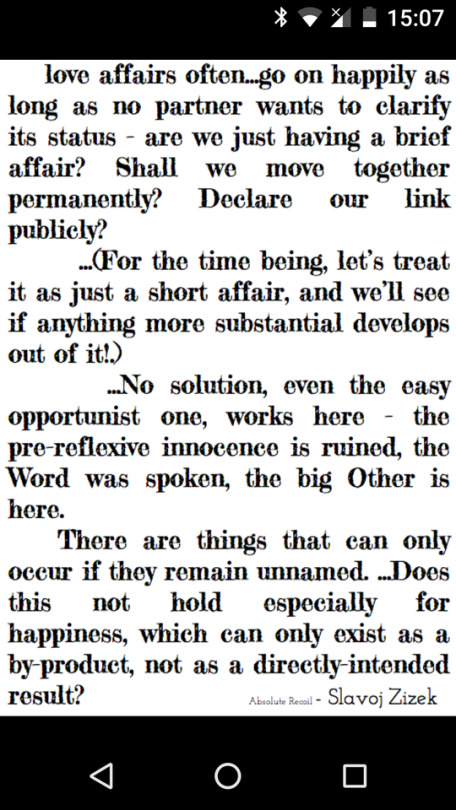
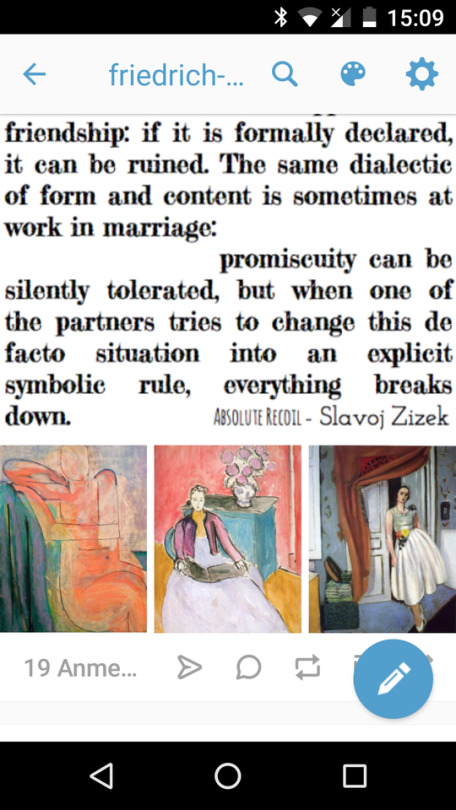
@mugasofer asked: I would be fascinated to hear you defend this claim.

***

It's just the Tree of Knowledge in the Garden of Eden. Or Zizek's favorite metaphor, Wile E. Coyote, which is the same thing.

***

(Okay, besides the last line about happiness, which is just a dumb platitude that attempts to mystify what makes people happy.)

What really works about Zizek's pop-philosophy writing style, is that he will give some very common everyday occurrence in normal life that is pretty weird when you think about it. Then he will give a psycho-economic explanation for it, based on Lacan or other critical theorists. This only works if you already empirically agree that his everyday example happens; it does not work for proving to you that such things do happen if that is not your experience.

In this case, he uses the example of "lovers who do not yet define their relationship." Are you flirting, are you dating, is this an affair yet, is this a relationship, all those ambiguous phases. Certainly in my experience this is a very common stage of most relationships. (For all the mockery the "Left Behind" novels get, they are an excellent depiction of the American Evangelical worldview, including the main character having just this sort of "undefined flirting" with the femme fatale.) Either you agree that exists as a phenomenon, or you don't. If you don't, I can't help you.

And the thing about these undefined lovers is that not only do they defy traditional answers to "what are you to each other," but they usually rely on not even asking the question. You can not even discuss "So, are we dating?" without it suddenly becoming awkward. See this parody from Reductress. The problem is not solely the labeling of the relationship, but even the consideration of what factors would determine the label. The magical moment of the new relationship relies on not questioning or even thinking about "what are you," but just going along with the ride.

This is the natural contradiction and mystification of ideology, where you can go along happily so long as you never ask the hard questions that challenge the ideology. We were just talking about progressive ideology's unwillingness to ask the question "which of our myriad causes is the most important?" or you can look at Republican ideology's inability to draw the line "how far would Trump have to go before you abandon him?"

This is our favorite coyote, who can run on air so long as he never notices. The minute he looks down, and becomes aware of his impossible state, is only then when he succumbs to gravity.

The concept of "innocence" is similarly highly ideological. Innocence is not just "the lack of doing evil" but lack of awareness of the possibly of doing evil. That is why a child who sees a brutal murder is "robbed of their innocence." Or if someone is offered sexual favors, there is no "innocent" answer to it - they must suddenly consider whether they want that or not, and in doing so they have considered sex, and have entered maturity. (Or as we know, the truly innocent answer is to be so naive you don't understand the offer, and continue on blithely.)

This is why the Fruit of Knowledge destroyed the Garden of Eden. Because once Adam and Eve then had the choice between Good and Evil, once they knew Evil was a possibility, then they could no longer exist in a state of innocence, even if they chose Good.

We can see this Garden of Eden at work in most lively communities. A community floats on the magic of never explicitly defining their rules and boundaries. They might have some very loose ideals, or even a few rules made by geeks who enjoy that sort of thing, but it's still usually an open question of enforcement, and a million possible edge cases that no one wants to deal with. For instance, the comments section of a popular blog: the blog might enjoy proclaiming "Free Speech" and so declare a principle of anything goes in the comments, yet any blog that has done that and gotten a following has found that there become a lot of things you want to censor after all (for instance: commenters who harass other commenters for expressing the wrong opinion.) The blog author might vaguely know it's a possibly problem, but they hope it doesn't come up and they avoid thinking about it, because that's not the spirit of a fun-easy going community.

Once the harassment, and spam, and the desire to minimize disproportionately represented viewpoints, actually happen, then the leader(s) of the community have some very awkward decisions to make. And while some answers are worse than others, it is the mere experience of having to debate those questions that destroy the group's innocence. Things are now less fun, and more stultifying, until you find another community. And that newer community rarely has "found an answer" to these awkward questions, so much as it is once again a place where you can pretend you don't need an answer to them because the problem hasn't and never will come up. Thus continues the cycle of TAZ.

We should of course reject this form of innocence, willful ignorance of possibilities, and the attempts to float past ideological contradiction.

Saturday, May 13, 2017

Atheism, MTD, and Liberal Ideology

@isaacsapphire​ , @discoursedrome​, and @ranma-official​ are discussing “Why is the Left anti-atheist” in a few other threads. This deserves some response, though most of the discussion is just-so story-making about reasons the Left dislikes Atheists.
For one, no, atheists are not the outgroup for even the most cliche social justice progressives. Social justice ideology is still a coalition of many different groups, beliefs, and experiences and there are definitely many atheists among them. It’s not like if you met an avowed feminist, and it came up she was atheist, any of us would really be shocked. 
There are not purity squads going around testing whether people believe in god and pouncing on any sign of atheism, the way they are for libertarians, or HBD, or ever having voted Republican. (Well there may be some, the world is wide and surprising, but they’re certainly less conspicuous than the other varieties.)
Atheism is not the official belief of progressive ideology these days, and in some ways it may be less cool than Suffi Islam or extremely non-specific spirituality, but it’s still a real part of the coalition.
So what’s going on here?
Well to some degree the answer is “cool liberalism doesn’t hate atheism, it just hates Richard Dawkins”, which is pretty self-explanatory. But I do think there is something more generalizable at issue.


@oligopsonoia​ was talking about Moral Therapeutic Deism as an important advance in philosophical/cultural technology. And indeed, it was great at getting people to stop killing each other over god.
MTD is the theology of cosmopolitan liberal ideology. Or it’s atheist version “Jesus may not have been the son of God, but I think he was a great moral teacher.” It’s very soft-hearted respect for all this “religion stuff” without fully buying into it. That way, our “Coalition of the Ascendent”, including both academic Leftists and Muslim immigrants, can all get along.
As passionate atheist writers and Christian philosophers both say, if God exists that is the most important fact ever. To them, everything you believe about the world should be derived from the existence of, or absence of God. This is a committed ethical stance.
Not only is that awkward for the coalition, that committed ethical stance is entirely antithetical to how ideology works. A mature ideology does not want people who take their philosophical commitments more seriously than anything else! Those people are inconvenient, annoying, and not easily moved.
Ideology wants reasonable people. It wants people who are part of the “broad movement” overall, much more than passionate commitment to one ideal. Social justice ideology wants investment in anti-racism, anti-sexism, anti-imperialism, anti-bad-corporations, anti-traditional religion, and a lot of other things while never answering which of those is the most important if they ever come in conflict. It uses a great deal of social pressure to convince people to never ask that question.
Atheism as a cause might be able to make peace with all the other religious minorities, but it will never be in harmony with MTD. It takes God seriously, and taking something truly seriously, putting the intellectual foundation from first principles above any social necessity, is the predator to ideologies.
It’s not cool. It’s not harmonious. You can have your atheism, just don’t take it too seriously, and you be more on board making fun of Ivanka Trump’s fashion than trying to debate the source of morality in a God-less world, when you’re part of the ideological culture. (Dear lord, do not question “what is the source of our moral certainty.” That must always be assumed to be shared by everyone without any need for explanation or justification.)